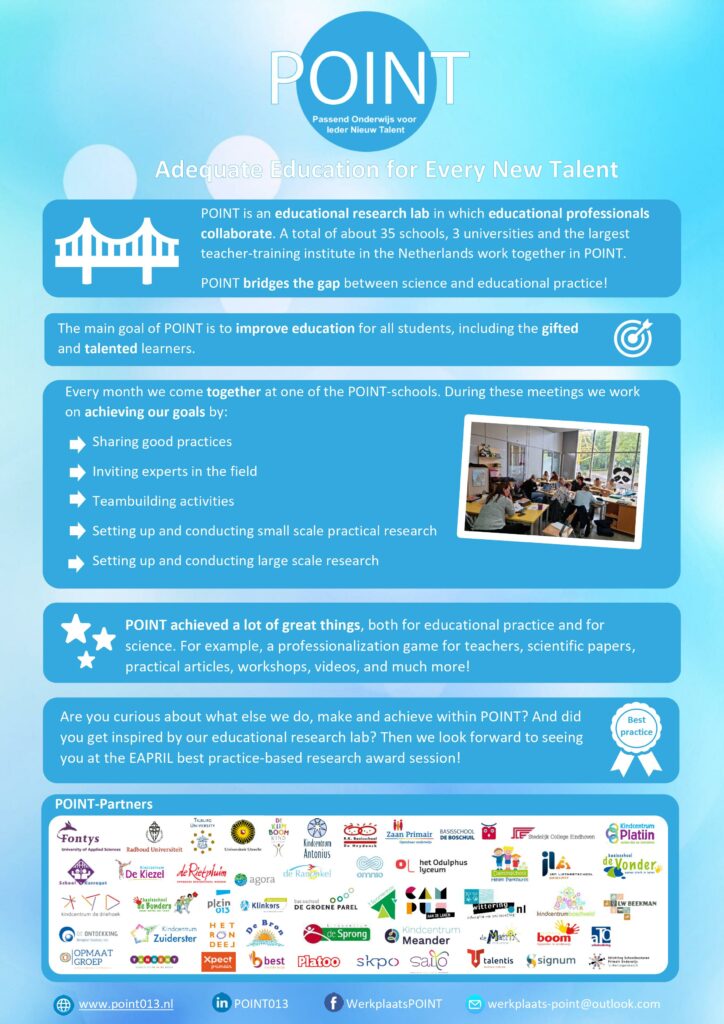
POINT stands for ‘Adequate Education for Every New Talent’. POINT is a Dutch fieldlab for educational research where primary school teachers, teacher-educators and researchers work together to improve education for all pupils – including gifted pupils – and to link educational practice and scientific research.
Every school year eight POINT-meetings are organized where the POINT-participants meet each other. The educational research-lab POINT aims for:
- Shaping a sustainable professional learning community, in which teachers, teacher-educators and researchers work together on themes that are in line with tailored education for gifted pupils;
- Knowledge development and knowledge sharing by teachers, teacher-educators and researchers on the theme of giftedness;
- Development of a research-oriented attitude and capacity among the participating POINT-teachers. Development of a practice-sensitive attitude among the participating POINT-researchers;
- Sharing insights from our studies on giftedness with other people interested, nationally and internationally in all ways possible (publications, presentations, video’s, games and so on).
During the POINT-meetings, knowledge is shared from practice – e.g. through ‘good practices’ – and science – e.g. by presentations of experts in the field of giftedness. Knowledge development, knowledge sharing and the development of research skills is shaped by ‘Applied research’ and ‘practice oriented scientific research’:
- Applied research are the small-scale studies that teachers conduct at their own school. This research is conducted in response to a question from their school. The teacher is guided in this by a teacher-educator or researcher.
- Practice oriented scientific research are the large-scale studies that the researchers, in collaboration with teachers, conduct at all POINT-schools. During the POINT-meeting, teachers share questions about giftedness and appropriate education that come from their schools. In response to these questions, knowledge is shared from educational practice and from science. Thereafter, they collaborate on collective demand articulation and conduct collective research. After implementation, the research results are shared internally (within POINT), regionally (at primary schools and colleges), nationally and internationally.
Since the start of POINT013 in 2016, various products have been developed and successes have been achieved with regard to knowledge development and knowledge sharing about giftedness. For example:
- Scientific– and practical publications.
- Presentations at various conferences.
- Professionalization game ‘enIQma‘
- The tool ‘KarakterKracht‘ to improve pupils’ knowledge about their self-concept
- The tool ‘Onbeschrijflijk – to the point‘ to stimulate the (creative) writing skills and higher order thinking skills of pupils
- Material descriptions (about teaching material for (gifted) pupils)
- Knowledge videoclips
EAPRIL Conference 2021 – Best practice-based research award
In 2021, POINT received the EAPRIL Best Practice-Based Research Award, an annual recognition given to an outstanding and innovative project focused on learning and development in the workplace and educational settings. We are honored to have received this award.
ECHA Conference 2024 – Oral presentations
POINT participated in the 19th ECHA Conference in Thessaloniki, where two of our researchers presented a paper on behalf of POINT. Kim Lijbers presented the paper, titled ‘Cognitive Profiles of Gifted Discrepant Readers in Primary Education’. Kim Smeets presented the paper, titled ‘The effects of special educational needs and socioeconomic status on teachers’ and parents’ judgements of pupils’ cognitive abilities’. The references:
Lijbers, K., Van Viersen, S., Van Tilborg, A. J., & Bakx, A. (In press). Cognitive Profiles of Gifted Discrepant Readers in Primary Education. Gifted Child Quaterly.
Smeets, K., Rohaan, E., Van der Ven, S., & Bakx, A. (2024). The effects of special educational needs and socioeconomic status on teachers’ and parents’ judgements of pupils’ cognitive abilities. British Journal of Educational Psychology. https://doi.org/10.1111/bjep.12719